

Overview
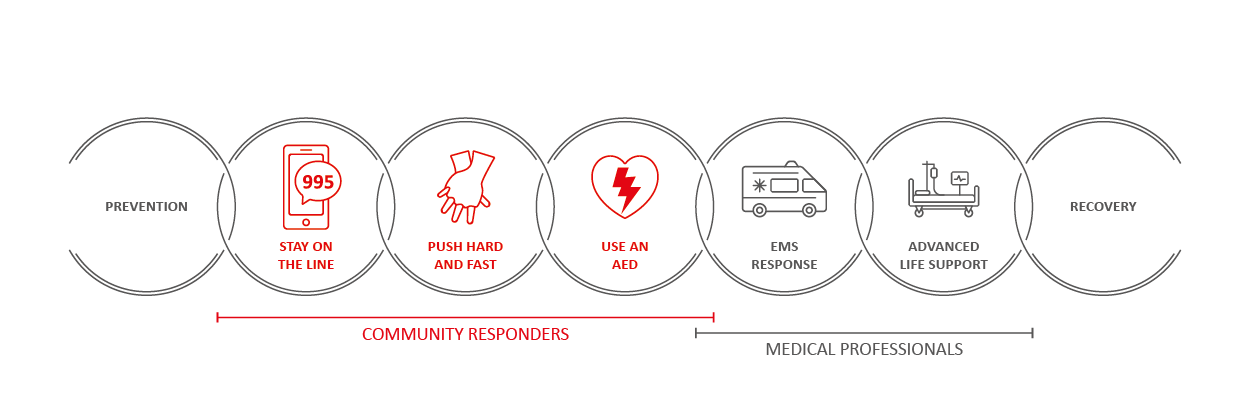
Sudden cardiac arrest (SCA) occurs when the heart suddenly stops beating. The victim is unresponsive and not breathing normally. Mortality rates are usually high, and timely intervention, also known as the ‘Chain of Survival,’ is critical to increase the victim’s chances of survival. In 2021, more than 3,600 Out-of-Hospital Cardiac Arrest (OHCA) cases occurred in Singapore.
Key interventions in the Chain of Survival include calling 995 for Emergency Medical Services, administering bystander CardioPulmonary Resuscitation (CPR), and using an Automated External Defibrillator (AED). These interventions can be performed by any layperson, which highlights the importance of widespread public education. We believe that investing in the health literacy and awareness of our population is crucial for improving bystander CPR and enhancing cardiac arrest survival in our community over the long term.
In line with this objective, the Dispatcher-Assisted first REsponder (DARE) programme was launched. Fully funded by Singapore's Ministry of Health (MOH) and implemented by the Unit of Pre-hospital Emergency Care (UPEC), DARE strengthens the community's responsiveness to medical emergencies and raises preparedness levels. The session is a 45-minute programme, comprising training through educational videos and a practical session without technical terminologies. Participants are taught how to respond effectively when witnessing a cardiac arrest with step-by-step guidance from 995 specialists.
Building on the success of initiatives like DARE, the focus has shifted to expand to a concerted effort through the National Community Emergency and Resilience (NCER) workgroup. Co-chaired by both UPEC and the Singapore Civil Defence Force (SCDF), the workgroup aims to drive strategies to strengthen Singapore’s readiness, resilience, and responsiveness to out-of-hospital medical emergencies. The NCER workgroup is working toward a shared goal to equip one million people with CPR+AED knowledge and skills and increase myResponder App sign-ups to 500,000 by 2027.
In addition to training and awareness, recognition of public acts is also crucial, especially those that have life-saving impacts. UPEC's Community Responsiveness team oversees the Survivor Awards Singapore, where OHCA survivors can express their gratitude to their rescuers, further motivating community participation and fostering a culture of life-saving action.